Newsletter Sign-up

Name(Required)

Melvin Carter

Senior Advisor

Melvin is a nationally recognized systems innovator and two-term Mayor of Saint Paul known for advancing equity-centered, community-driven change. As chief executive of an $800 million municipal enterprise, he has led transformative public-private partnerships, guided the city through overlapping crises, and launched nationally recognized models such as Community-First Public Safety and CollegeBound Saint Paul. Melvin brings operational rigor and a deeply human leadership philosophy focused on generational impact and inclusive economic growth.

Drinal Foster

Chief Impact Officer

Drinal oversees performance measurement, operational excellence, and long-term impact tracking for GroundBreak Coalition, ensuring its transformational goals are matched by disciplined execution. A 30-year Wells Fargo veteran and Senior Vice President, she has led enterprise-wide operational and customer engagement initiatives with a strong focus on equity and inclusion. An award-winning executive and civic leader, Drinal brings deep systems expertise to align strategy, accountability, and innovation in building a more inclusive financial system.

Mike LaFave

Chief of Staff

Mike serves as Chief of Staff for the GroundBreak Coalition, overseeing governance, operations, and coordinated implementation as the organization expands its impact. With more than 25 years of senior leadership in community development—including roles at Family Housing Fund, Project for Pride in Living, and Neighborhood Development Center—he has dedicated his career to expanding access to housing, capital, and entrepreneurship. Mike brings strategic discipline and partnership-driven leadership to advance equitable wealth building across Minneapolis–St. Paul.

Gwen King-Lunde

Executive Administrator & Operations Coordinator

Gwen serves as Executive Administrator and Operations Coordinator for the GroundBreak Coalition, strengthening cross-functional coordination and ensuring the organization’s operations run seamlessly in service of its mission. With a background in nonprofit administration, executive support, and program management, she brings expertise in stakeholder engagement, budget oversight, and high-level communications.

Eric White

Chief Investment Officer

Eric leads the Capital Mobilization aspects of the GroundBreak Coalition, ensuring that our financial institution and community lending partners in entrepreneurship, homeownership, and neighborhood development are working seamlessly in support of the wealth builders we serve. With nearly 20 years experience in impact and investing, mobilizing hundreds of millions of dollars for economic justice at Cogent Consulting, the Bush Foundation, and The Financial Services Consulting Group, mobilizing capital equitably is his life’s work.

EMAIL

Adair Mosley

CEO

Adair leads the GroundBreak Coalition with a deep commitment to equity-driven transformation and creating new pathways for generational prosperity across Minnesota. With more than a decade of experience leading social impact organizations—including serving as CEO of African American Leadership Forum and President & CEO at Pillsbury United Communities—his career has been dedicated to rallying talent, launching innovative initiatives, and building a more equitable financial system for all.

EMAIL

What is ABH (Advancing Black Homeownership)?

This first-of-its-kind program combines flexible underwriting criteria with financial assistance to help Black or African-American buyers overcome historically inequitable housing practices and buy their first home. The ABH Community Fund is a collaboration between the Minnesota Homeownership Center, Twin Cities Habitat for Humanity, Build Wealth Minnesota, NeighborWorks Home Partners, PRG, Inc., Project for Pride in Living (PPL) and GroundBreak Coalition.

When Dollars Circulate Locally

A few weeks ago, we shared what the data tells us about homeownership: when families have a stable place to live, the return shows up across generations. For every dollar invested in helping families buy homes, communities see $5.25 in return. Across 11,000 households, that’s $283 million invested and $1.48 billion in economic benefits over time. 

Business development is another part of that story.

The latest social return analysis shows that when access to capital and support reaches the businesses that have been systemically shut out, the return is also significant. The report looks at nearly $560 million in business development efforts over the next decade and projects $1.1 billion in societal benefits, with a social return of $19 for every dollar invested.

Across 5,000 businesses, each entrepreneur supported is projected to gain $117,836 in additional net income. Those businesses are expected to create nearly 8,000 jobs over 10 years, with each employee projected to gain $68,231 in additional net income.

That means more income for business owners and workers. More stability for households. More money moving through local businesses and neighborhoods. The report also projects approximately $139 million in additional tax revenue from income gains alone.

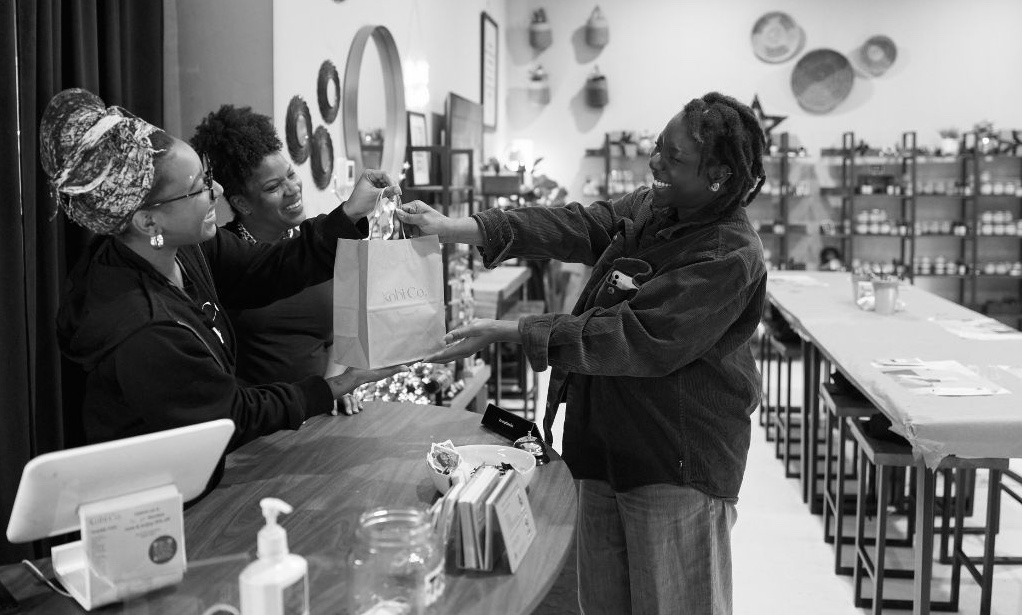
When a local business has the right support at the right time, it can become a foundational part of the community. It can hire local. It can buy from another local vendor. It can help a family build savings, take on a lease, make payroll, or plan beyond the next emergency.

That is how more dollars keep circulating in the community.

For Black entrepreneurs and entrepreneurs of color, access to that kind of support has never been equal. Redlining, credit discrimination, limited access to generational wealth, and long-standing barriers have shaped who gets capital, when they get it, and what terms they are asked to accept.

Business development is not separate from the work of closing the racial wealth gap. It is one of the ways we get there.

In the 3rd and final part of of this series, we’ll turn to commercial development and look at what the analysis tells us about ownership, investment, and what it means when communities have a stronger stake in the places being built around them. 

Read the full report here.

In Gratitude, 

The GroundBreak Coalition Team
Scroll to Top